



City of wine, horses, flamenco, and motor
Few places in Spain have international recognition like Jerez. Thanks to its <a href="https://www.sherry.wine/" rel="noopener noreferrer" target="_blank">wine - “jerez” or “sherry”</a>-, its equestrian and bullfighting traditions, flamenco, and motorsports, this Andalusian city’s name crossed borders long ago. Phoenicians arrived here 3,000 years ago to establish the colony called Xera, later known as Ceret under Roman rule, and Sheres or Xeres as an Arab stronghold. The prosperous trade of its famous wines with the English began under the Catholic Monarchs.
The Muslims left a deep mark on the city, seen in the layout of neighborhoods in the heart of the old Arab medina, and the <a href="https://es.wikipedia.org/wiki/Alc%C3%A1zar_de_Jerez_de_la_Frontera" rel="noopener noreferrer" target="_blank">Alcázar</a>, declared a monument of historical-artistic interest. Here you’ll find one of the few surviving 12th-century mosque minarets in the world, next to the Christian church built after the city’s conquest by Alfonso X. The square tower, where you can view Jerez, and the Arab baths are also worth visiting.
The 17th-18th centuries marked the true economic boom. From then on, the landscape changed to form the historical nucleus that exists today and earned Jerez’s designation as a historical-artistic monument. Jerez is renowned for the magnificent Renaissance and Baroque palaces of its noble families, its majestic churches, and convents. Discover its beauty <a href="https://www.andalucia.org/es/jerez-de-la-frontera">here</a>.
Highly recommended are also visits to the <a href="https://palaciodomecq.com/" rel="noopener noreferrer" target="_blank">Palacio Domecq</a> and the <a href="https://www.palaciodelvirreylaserna.com/" rel="noopener noreferrer" target="_blank">Palacio Virrey Laserna</a>, which are integral parts of Jerez's history.
Uniqueness
The city boasts many valuable examples of Gothic architecture. In the <a href="https://es.wikipedia.org/wiki/Santiago_(Jerez_de_la_Frontera)" rel="noopener noreferrer" target="_blank">Santiago neighborhood</a>, the birthplace of bulería, lies the 15th-century Santiago church, which holds the image of Jesus of the Capture, attributed to La Roldana. The conventual church of Santo Domingo and San Marcos church are also fine examples of this style. All house some of the statues that will be carried through the streets during Holy Week (a major festival in Jerez along with <strong>the Horse Fair</strong>).
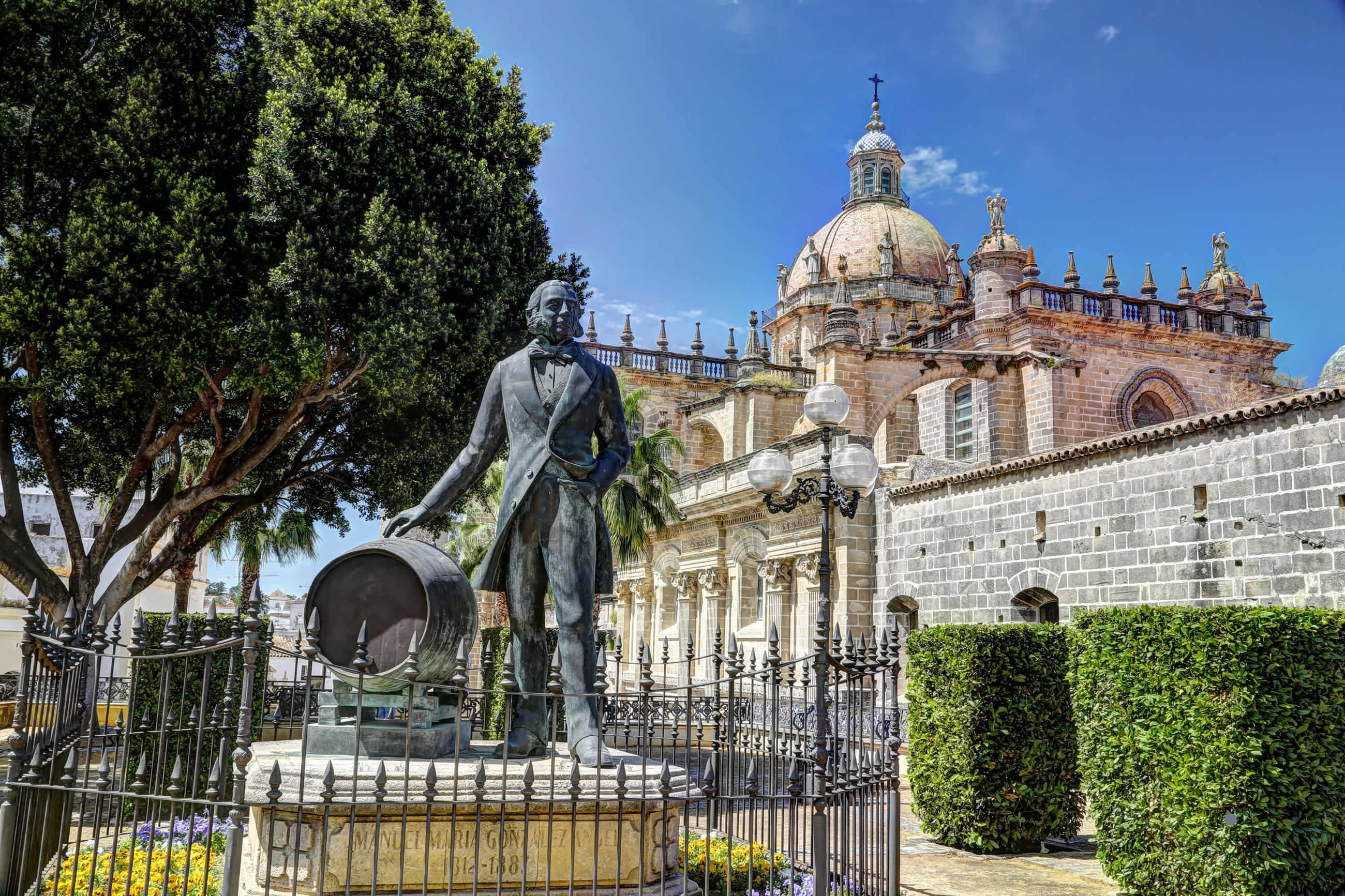
Very close by is the <a href="https://es.wikipedia.org/wiki/Catedral_de_Jerez_de_la_Frontera" rel="noopener noreferrer" target="_blank">cathedral</a>, a beautiful Baroque masterpiece of monumental scale. Inside, highlights include the choir stalls, Zurbarán’s Virgin Child, an Immaculate Conception by Vaccaro, a crucifix by Juan de Arce, and the 14th-century Gothic Christ of the Beam. The adjoining tower is built over the old Arab minaret.
<a href="https://es.wikipedia.org/wiki/Iglesia_de_San_Dionisio_(Jerez_de_la_Frontera)" rel="noopener noreferrer" target="_blank">SAN DIONISIO</a>. This church is one of the best examples of Jerez Mudéjar. It is located in one of Jerez’s most charming squares, Plaza de la Asunción, which also hosts the town hall, a splendid Renaissance work.
<a href="https://es.wikipedia.org/wiki/Cartuja_de_Jerez_de_la_Frontera" rel="noopener noreferrer" target="_blank">CARTUJA DE SANTA MARÍA DE LA DEFENSIÓN</a>. Declared a Cultural Heritage Site, this monastery is considered the most important religious monument in the province. Flamboyant Gothic, Plateresque Renaissance, and Baroque styles come together in a harmonious structure with stunning areas like the entrance porch, the chapel of Santa María de la Defensión, and the Patio of the Myrtles. It can be visited by appointment or on specific open days. Besides its artistic value, the charterhouse has gone down in history as the birthplace of the Cartujano horse breed. Starting in the 16th and 17th centuries, Jerez attracted merchants, especially in the wine sector, which shaped the city with many wineries and mansions.
But if you want to truly experience Jerez and its people, nothing beats a stroll along Calle Larga, the commercial and nerve center of the city. The heartbeat of the city is felt here, with the best shops and many terraces to enjoy a glass of wine and delicious tapas. You can visit Plaza del Arenal, the most iconic square in Jerez, as well as El Mamelón, Plaza del Banco, bustling with life and activity, and Plaza Plateros or Plaza Rafael Rivero, cozy spots filled with terraces where you can savor the city's rich gastronomy.
For leisure time, there are several options: <strong>the speed circuit</strong>, which often hosts a World Motorcycle Championship event; the zoo, which includes a botanical garden; and museums like the Atalaya, also known as the Palace of Time, which houses a fine collection of clocks from all eras.
<a href="https://es.wikipedia.org/wiki/San_Miguel_(Jerez_de_la_Frontera)" rel="noopener noreferrer" target="_blank">SAN MIGUEL</a>. A neighborhood with a gypsy flavor, the birthplace of <strong>Lola Flores</strong>, it is one of Jerez’s most distinguished and popular areas. The palace houses, such as the Palacio de Villapanés, add to the unique identity of this neighborhood. At its heart stands the church of the same name, built in the 15th century in Gothic style, though its facade is a fine example of Baroque. The main altarpiece, by Martínez Montañés and Juan de Arce, is worth seeing.
Fuente Cádiz Turismo www.cadizturismo.com